



For further information about Wave Springs click here
You can call the AFC Europe team on 01435 866011 or email to enquiries@afceur.com.

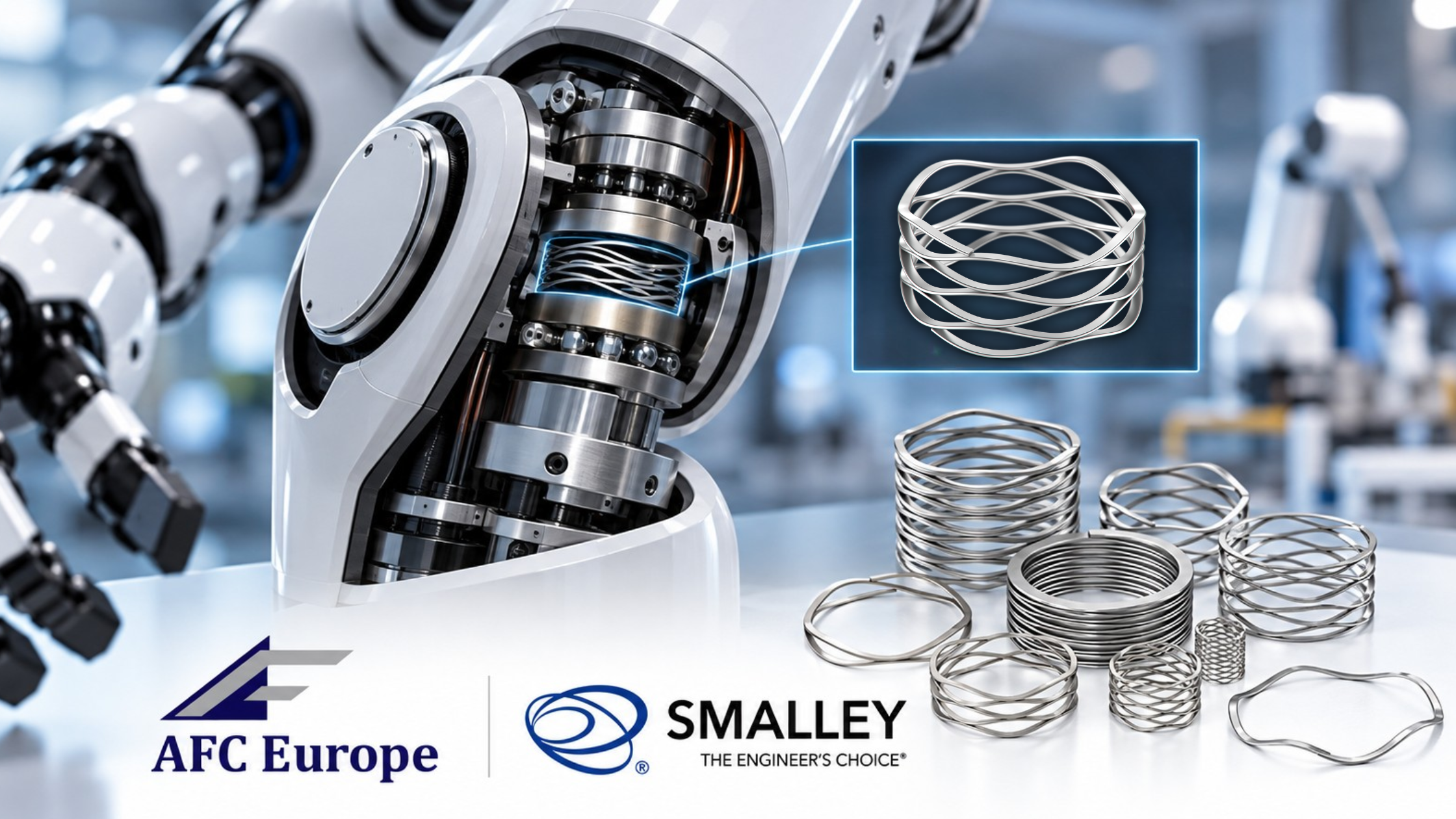
From humanoid hands and collaborative robots to autonomous systems and miniature surgical instruments, engineers are being challenged to fit increasing levels of mechanical and electronic functionality into ever smaller spaces.
It is creating a battle for every millimetre inside the modern robot. Motors, bearings, gearboxes, sensors, encoders, electronics and cabling all compete for space within joints and actuators.
At the same time, these mechanisms still require controlled forces for functions such as bearing preload, tolerance compensation and maintaining contact between moving components.
This is where wave spring technology can offer a significant advantage.
Unlike a conventional round-wire compression spring, a Smalley Wave Spring is manufactured from flat wire formed into a series of precisely controlled waves.
This geometry enables a Crest-to-Crest® Wave Spring to provide equivalent spring force and deflection to a conventional coil spring while reducing operating height by as much as 50%.
For a robotics engineer, that is much more than a component-level saving. Reducing the axial space required by a spring can potentially shorten an actuator or joint, provide additional room for sensors or electronics, allow a larger bearing to be incorporated or contribute to reducing the overall size and weight of the robot.
And those advantages become increasingly significant as robotics evolves. Humanoid robots, for example, require multiple compact actuators and articulated joints to reproduce human-like movement and dexterity. Collaborative robots must combine capability with compact dimensions to operate effectively alongside people. Autonomous mobile robots benefit from reductions in mass and energy consumption.
Medical robotics is pushing miniaturisation even further, with development encompassing single-port surgical robots, flexible endoscopic systems, capsule robots and even micro-robotics.
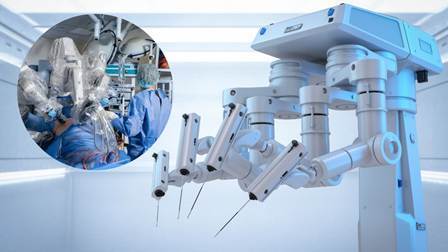
Across these applications, simply making components smaller isn't enough. The real challenge is retaining performance while reducing the mechanical envelope.
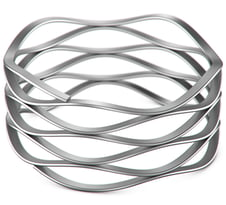 Wave springs can provide controlled axial forces for functions including bearing preload, tolerance compensation, sealing and maintaining mechanical contact.
Different configurations allow their performance to be adapted to the application. Single-turn wave springs can provide precise loads where both axial and radial space are restricted. Multi-turn Crest-to-Crest® springs provide greater deflection while maintaining a compact operating height.
Nested designs can deliver considerably higher forces, while Smalley's Nestawave® technology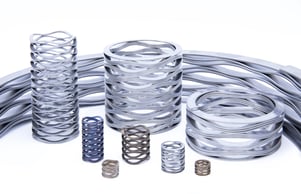 combines high force capability with useful travel from a single continuous piece of flat wire.
The edge-wound manufacturing process also creates considerable design flexibility. Wire thickness, radial wall, number of waves, turns, material and other characteristics can be adjusted to influence load, spring rate, deflection and working height.
For highly optimised robotic mechanisms, this means the spring can potentially be engineered around the available space rather than forcing the surrounding assembly to accommodate a conventional spring.
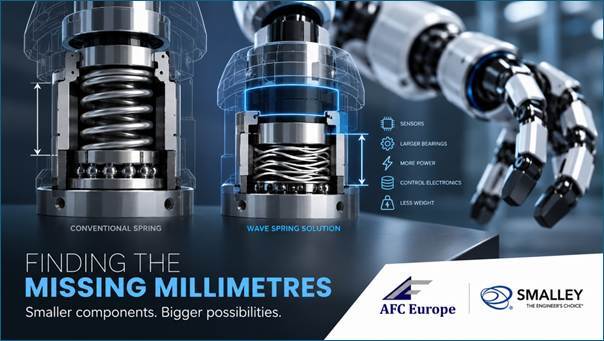
The significance of this becomes clearer when looking at the direction in which robotics is travelling.
Artificial intelligence may be providing robots with dramatically greater capabilities, but those capabilities still have to be translated into physical movement. More sensors, processors and electronics inevitably increase the competition for space within the mechanical architecture.
A component capable of providing the required mechanical performance while occupying substantially less space therefore has an influence beyond its own function.
It can help change the architecture around it.
Smalley, based in the USA, pioneered the edge-wound wave spring and is a world-leading specialist manufacturer of Wave Springs and precision retaining rings.
AFC Europe is Smalley's exclusive design and supply partner in Europe, giving European robotics and automation engineers access to Smalley technology together with technical support in identifying standard or custom solutions for demanding applications.
For designers facing the challenge of miniaturisation, the greatest opportunity may not simply be replacing a conventional coil spring with a wave spring. It is asking what could be done with the space that replacement releases. A shorter actuator? A smaller joint? More sensing? Less weight? Greater functionality?
As robotics becomes increasingly sophisticated, finding a few extra millimetres inside a mechanism is going to make a big difference.
For support with your next engineering design project, in robotics or any other sector, click here to get in touch with the AFC Europe design support team or drop an email to enquiries@afceur.com.